Joining Invar to Other Metals: Brazing, Bolting and Bonding
Invar is chosen because it hardly changes size when the temperature moves. Then someone has to attach it to something that does. A steel bracket, an aluminum base, a glass mirror or a copper heat sink all expand ten to twenty times more than the Invar they touch. The joint is where the stability of the Invar part is either kept or lost. This guide covers the three main joining routes, brazing, bolting and bonding, and what each does to the part.
The CTE mismatch problem
Every pair of joined materials with different expansion behaves like a bimetallic strip. When the temperature rises, the high-CTE side wants to grow more and the low-CTE side holds back. Something has to give: the joint stretches, the assembly bows or one part slips.
| Pair | Typical CTE (×10⁻⁶ per K) | Growth over 300 mm for +10 K |
|---|---|---|
| Invar 36 | 1.3 | about 3.9 µm |
| Kovar | 5.0 to 5.5 | about 15 to 17 µm |
| Titanium (Ti-6Al-4V) | 8.6 | about 26 µm |
| Carbon steel | 11.5 | about 35 µm |
| Stainless 304 | 17 | about 51 µm |
| Aluminum 6061 | 23 | about 69 µm |
Typical handbook values at room temperature. Confirm for your own grades.
The difference between Invar and aluminum over 300 mm and 10 K is about 65 µm. That is far larger than the tolerances Invar is bought to hold. A joint that ignores this either cracks, deforms the Invar or releases and rattles. The three joining methods differ mainly in how they deal with that gap.
Brazing
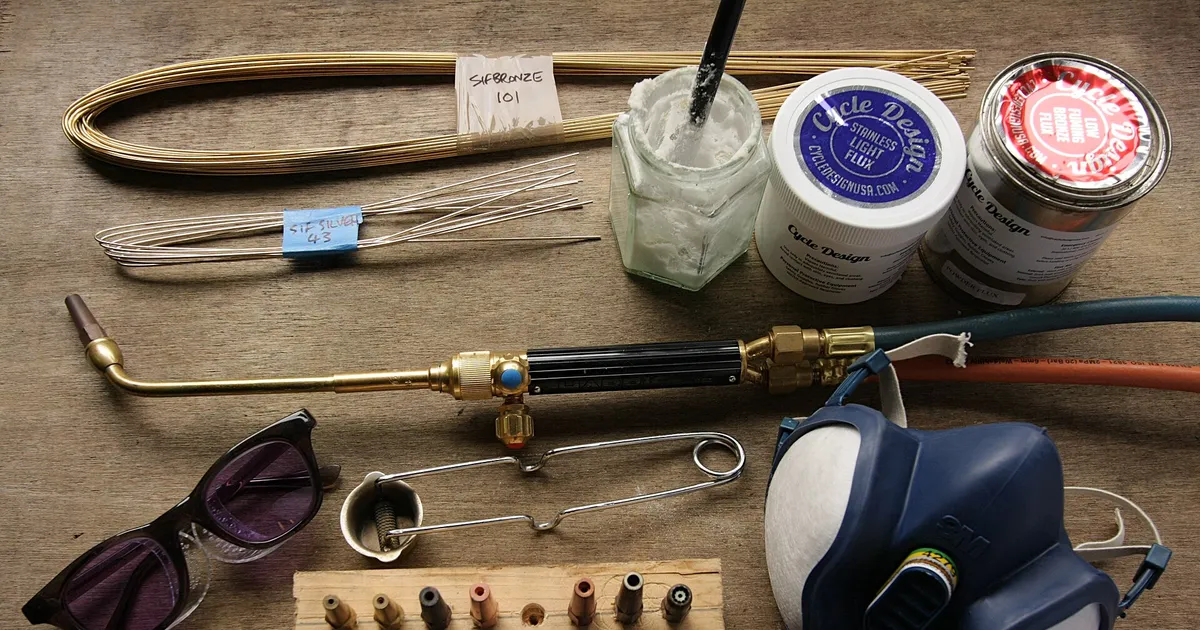
Brazing joins parts with a filler metal that melts above about 450 °C but below the melting point of the parts. For Invar the common fillers are silver-copper alloys, and the process is usually vacuum or controlled-atmosphere furnace brazing, though torch brazing is used for small, non-critical work.
What brazing gives you:
- A continuous, leak-tight joint suited to vacuum and fluid parts
- Strong joints between Invar and copper, steel, Kovar or nickel
- Multiple joints made in a single furnace cycle
What it costs the Invar:
- It resets the thermal history. Typical brazing temperatures of 700 to 900 °C are far above the 315 to 345 °C used for stress relief. Any earlier stabilization is lost, and the part must be stress relieved and stabilized again afterward. See Invar stress relief in machining for the cycle.
- Surface oxide and carbon. Invar needs clean, oxide-free faces. A protective atmosphere, vacuum or flux is required, and nickel plating of the joint face is common to improve wetting.
- Cool-down stress. The filler solidifies first and the pair then shrinks at different rates. The mismatch is locked into the joint and shows up as residual stress or bow.
- Filler is not Invar. The braze joint is a small volume with its own CTE. In a precision frame, a thick joint can matter.
Brazing therefore comes before final machining wherever possible. Rough machine, braze, stress relieve, finish machine, stabilize. If a face must be flat after brazing, leave extra stock for it.
Bolting
Bolting is the cheapest and most flexible route and the one where designers most often meet trouble. A bolted joint pins two parts together at each fastener. If the parts expand differently, the pins fight each other.
Common ways to handle it:
- Slotted holes in the high-CTE part, with one round dowel hole to fix position. The part can grow along the slots without pushing on the Invar.
- Flexure mounts that bend in one direction and stay stiff in the others. These are the preferred route in optical benches and telescope structures, as shown in Invar optical mounts and telescope structures.
- Spring washers (Belleville or wave) that keep the clamp load steady while the parts move.
- Matching fasteners. A stainless steel bolt in an Invar plate has a CTE mismatch of about 15 ×10⁻⁶ per K and gains or loses preload with temperature. Invar or Super Invar fasteners, or titanium as a compromise, reduce this.
- Threaded inserts. Threads in Invar are soft and tear easily. Invar thread inserts covers when and how to use them.
Torque needs care. Over-tightening distorts a thin Invar part by more than any temperature swing. The clamp force should be spread over a stiff washer or pad, as described in Invar fixturing and workholding.
Bonding
Adhesive bonding is the usual route when Invar must be joined to glass, ceramic or composite, because the filler can be soft enough to absorb the mismatch. It also avoids heat, so earlier stabilization survives.
Four factors decide whether a bond works:
| Factor | What to control | Typical target |
|---|---|---|
| Bondline thickness | Uniform gap set by shims or beads | 0.1 to 0.25 mm |
| Cure shrinkage | Low-shrink adhesive or staged cure | Lower is better for optics |
| Modulus | Soft adhesive for large mismatch, stiff for load | Match to the joint |
| Surface prep | Clean, degreased, lightly abraded or primed | Per the adhesive maker |
Typical practice only. Follow the adhesive supplier’s data and test a coupon.
Large mismatches such as glass on aluminum use a compliant adhesive with a thick bondline. A mirror bonded to an Invar cell can use a stiffer one because the mismatch is small. Adhesive also creeps and absorbs moisture, so long-term drift is a question to test, not assume.
Soldering, welding and other low-heat options
Not every joint needs the heat of a braze. Soft soldering with tin-based alloys runs at 200 to 250 °C, which is below the stress relief range, so it does not undo earlier stabilization. Invar solders readily once it is cleaned and fluxed, and nickel plating helps. Soldered joints are weak and creep under load, so they suit electrical and light mechanical connections, not structure.
Laser and electron beam welding put heat into a very small zone and cause little distortion. They suit thin sheet and small housings. TIG welding with Invar filler wire keeps the CTE of the joint close to the base metal, though it leaves a heat-affected zone and a weld bead that needs later stress relief. The trade-off between welded and machined-from-solid construction is set out in Invar welding versus machining. A weld between Invar and a dissimilar metal is a metallurgical question that needs a procedure qualified for the pair, so ask the shop for its procedure before relying on it.
Mechanical joining without heat or adhesive, such as press fits and shrink fits, also works. A steel sleeve pressed on an Invar shaft changes its grip with temperature, which is the same mismatch problem again. Shrink fits are better when the outer part is the Invar one, because heating the outer part opens the fit while the inner part stays cool.
Sequencing a joined Invar part
A joined part has more steps than a single piece, and the order decides whether the stability survives. A typical sequence for a brazed assembly:
- Rough machine each part with generous stock
- Clean, plate if needed and fixture the assembly for brazing
- Braze in a furnace and cool slowly
- Stress relieve the whole assembly
- Finish machine the critical faces and holes
- Stabilize at low temperature for a long hold
- Final inspect at 20 °C
For a bolted assembly the sequence is simpler, since each part is stress relieved and stabilized separately before final assembly. For a bonded one the Invar part is finished and stabilized first, then bonded, then given a controlled cure at modest temperature. Each route puts the last heating step either before the final machining or at a temperature too low to disturb it.
Test the sequence on a coupon first if the part is valuable. A coupon made of the same material, braze or bond pair and processed together can be measured before and after a thermal cycle to confirm the joint holds. See Invar thermal cycling tests for how such tests are run.
Which method fits which job
| Need | First choice | Reason |
|---|---|---|
| Vacuum tight joint to copper or Kovar | Brazing | Leak-tight, strong, handles many joints at once |
| Removable assembly to a steel or aluminum base | Bolting with flexures or slots | Absorbs mismatch, allows service |
| Glass or ceramic to Invar | Bonding | Low heat, compliant, preserves stabilization |
| Same-alloy structure | Welding with Invar filler | Matching CTE, see Invar welding versus machining |
| Thin sheet to a frame | Spot welding or bonding | Minimal heat input |
Hypothetical worked example
A buyer designs a 300 mm Invar optical base to sit on an aluminum chassis. The environment swings by 10 K. Numbers are hypothetical and typical.
- Free growth of the aluminum chassis over 300 mm is about 69 µm. The Invar base grows about 4 µm.
- If the base is bolted at four corners with tight holes, the 65 µm difference has nowhere to go. The base bows by tens of micrometers.
- If one corner takes a dowel and the other three use slots along the length, the aluminum slides under the base and the bow stays within a few micrometers.
- If the dowel is replaced by a small flexure at each corner, the base also resists any twisting from friction.
The cost of slots or flexures is small compared with an Invar base that no longer holds its flatness in service.
Testing a joint before committing to a lot
For a valuable assembly, run a small test before the full lot. Make two or three joints in the proposed way, cycle them between the temperature extremes and measure before and after. Brazed joints are checked for leaks and for distortion of the Invar part. Bolted joints are checked for preload loss and shifts in position. Bonded joints are checked for shear strength and for movement of the bond line. The test costs a few days and a few parts, and it settles questions that calculation cannot, such as how the real adhesive behaves in the real gap. Invar thermal cycling tests describes how such cycles are set up.
What to put on the drawing and in the RFQ
- The mating materials and the temperature range of service
- Which joint type is expected, or leave it open and ask for the shop’s view
- For brazing, the filler specification and whether the part is stabilized afterward
- For bolted joints, which holes are slotted, which are dowels and the torque
- For bonding, the adhesive, bondline and cure schedule
Send the drawing through the RFQ form with the mating materials listed and we match you with shops that have run Invar joints before. For handbook values see the Invar reference data and the Invar 36 machining page. If the joint is to glass or a hermetic seal, Kovar glass-to-metal seal parts covers the alloy that matches borosilicate glass.
See also: thermal expansion mismatch calculator, to size the mismatch a joint has to take.
Frequently asked questions
Can Invar be brazed to steel or copper?
Yes. Invar is a nickel-iron alloy that wets well with silver-copper filler metals in a clean furnace or flame process, and it is often brazed in vacuum or in a protective atmosphere. The parts must be clean and free of oxide, and the joint design must allow for the large CTE difference between Invar and the mating metal. The brazing temperature also resets the heat treatment, so stabilization is done after brazing.
How do you bolt Invar to aluminum without distorting it?
Give the aluminum a way to grow without pushing on the Invar. Typical solutions are slotted holes with one fixed dowel, a flexure mount that bends instead of loading the Invar or spring washers that keep the preload steady through a temperature swing. Tight bolts in tight holes force the two metals to move together, which bows the assembly.
What adhesive is best for bonding glass to Invar?
There is no single answer, since it depends on the glass, the load and the temperature range. Designers usually pick a low-shrinkage structural epoxy or a compliant silicone, set a controlled bondline thickness and test the joint through the real temperature range. Ask the adhesive maker for the shrinkage on cure and the CTE after cure, and ask the shop to run a bonded test coupon.
Reviewed against
- AWS A5.8/A5.8M, Specification for Filler Metals for Brazing and Braze Welding
- Wikipedia, Brazing
- Wikipedia, Invar
Values in this guide are typical handbook figures for planning. The mill certificate for your heat lot and the shop's quote for your geometry govern.
Need a quote for this part?
Send the drawing. We match you with up to 3 shops that machine Invar and reply within 24 business hours.
Get matched with an Invar shopKeep reading
- Machining Invar vs Welding Invar: Choosing the Right Fabrication Path · Process
- Invar Fixturing and Workholding: Avoiding Distortion During Machining · Process
- Helicoil and Thread Insert Practices for Invar Threaded Holes · Process
- Invar for Optical Benches and Telescope Structures: Why CTE Stability Matters · Materials